简体中文
简体中文 English

Products
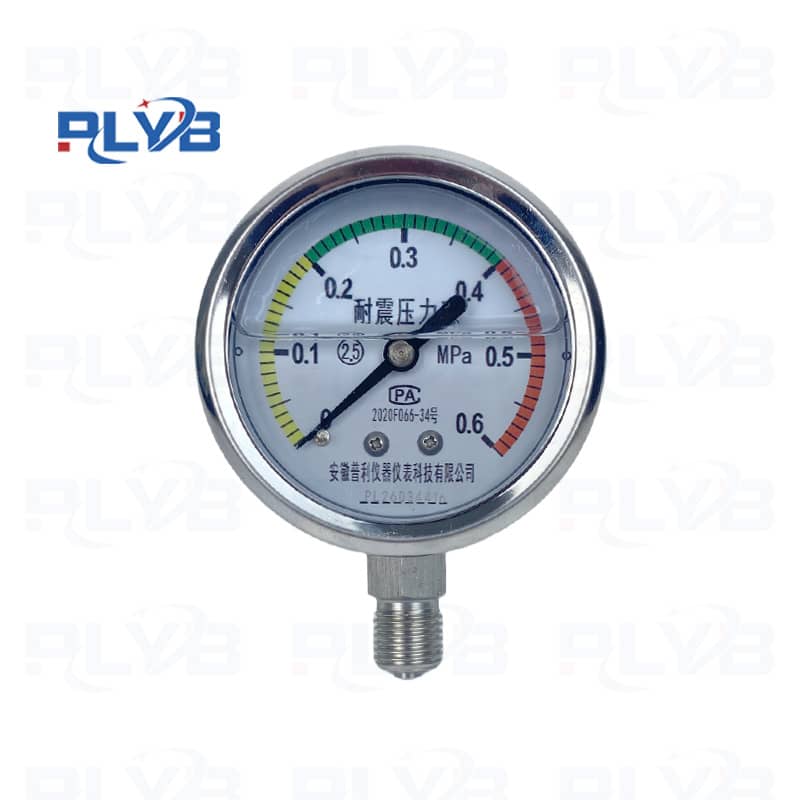
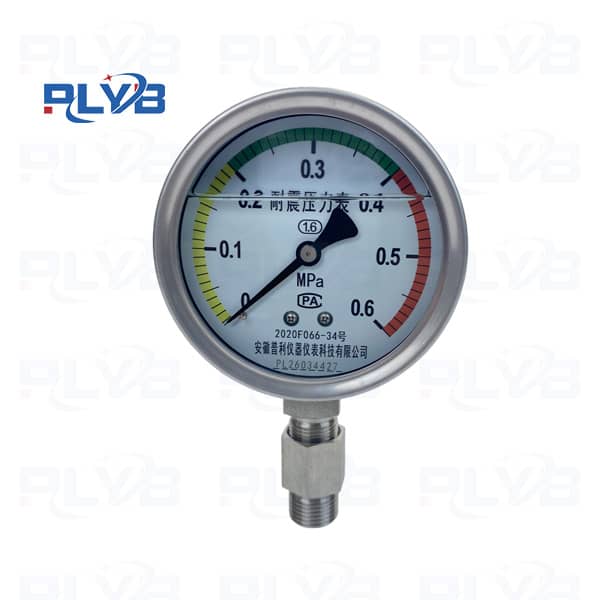
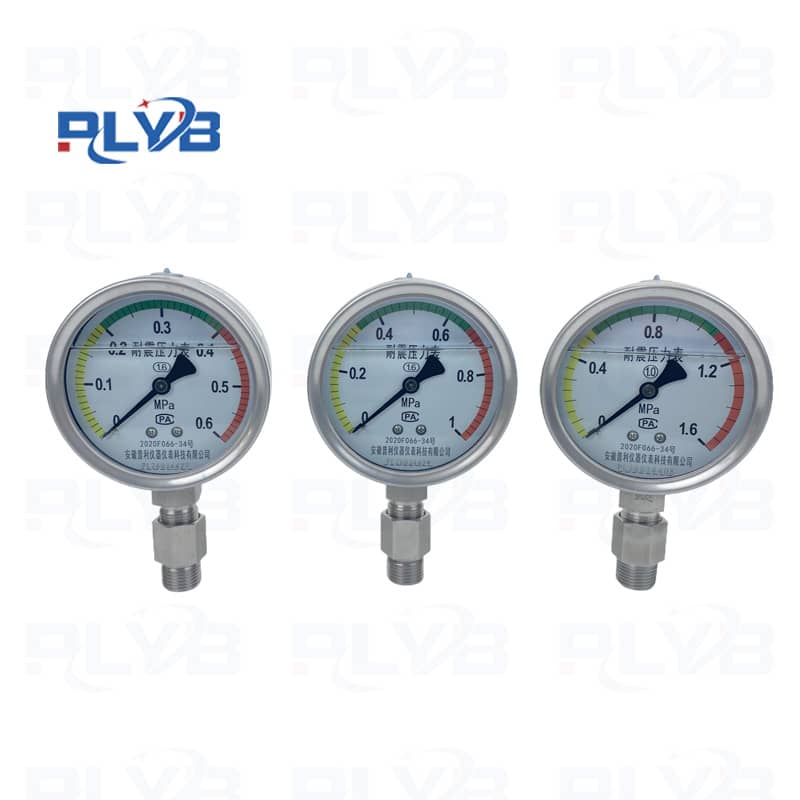
Φ63/100/150mm stainless steel seismic pressure gauge
- Product Description
-
Stainless steel shock-resistant pressure gauge: vibration-resistant, corrosion-resistant, and a reliable choice for industrial measurement
In conditions such as chemical, petroleum, hydraulic machinery, and shipbuilding with high vibration and high pulse pressure, ordinary pressure gauges often experience severe pointer vibration, difficult readings, and even rapid damage of the internal mechanism.
The stainless steel shock-resistant pressure gauge, through its all-stainless steel structure and internal damping fluid design, effectively solves the challenges of pressure measurement in strong vibration environments, making it an indispensable instrument for harsh working conditions.
What is a stainless steel shock-resistant pressure gauge?
Stainless steel shock-resistant pressure gauges (also known as oil-filled pressure gauges or shock-resistant pressure gauges) are made by filling the inside of the case with damping media such as glycerin or silicone oil inside the case. When the equipment experiences intense vibration or instantaneous pressure pulses, the damping fluid absorbs energy and slows the needle's movement, ensuring stable and clear readings. At the same time, both the casing and the liquid connection components are made of SUS304 or 316L stainless steel, offering excellent corrosion resistance.
Core Features and Advantages
Outstanding shock resistance: Internally filled with high-viscosity damping oil to effectively cushion mechanical vibrations and pressure pulsations, the hands remain stable and do not jitter, extending service life by 3~5 times.
All-stainless steel corrosion-resistant structure: The housing, movement, joints, and spring tubes are all made of high-quality stainless steel (standard 304, optional 316L), resistant to corrosion from acids, alkalis, salt spray, and humid environments.
High protection rating: fully sealed structure with protection ratings up to IP65/IP66, dustproof and water-resistant, suitable for outdoor or damp work areas.
Precise and stable measurement: accuracy level 1.6 (special customization level 1.0), good linearity, no drift during long-term operation.
Flexible customization: dial diameters (Φ63/100/150mm), range (-0.1MPa to 100MPa), mounting methods (radial, axial, flange), thread specifications (M20×1.5, G1/2, NPT1/2) can all be produced as needed.
Main technical parameters
Parameter items Specifications Nominal diameter Φ63mm / Φ100mm / Φ150mm Accuracy grade Level 1.6 (standard), Level 1.0 (optional) Measurement range -0.1~0MPa to 0~100MPa (positive pressure, negative pressure, composite pressure) Shell material SUS304 / SUS316 stainless steel Movement/spring tube 316L stainless steel Filling liquid Glycerin (standard), silicone oil (low-temperature/food-grade optional) Protection rating IP65 (Standard Type) / IP66 (Reinforced Sealing Type) Process connection Threaded M20×1.5, G1/2, NPT1/2, or flange connections Ambient temperature -40°C~+70°C (no oil filling); -20°C~+60°C (oil application) Typical application scenarios
Stainless steel shock-resistant pressure gauges are widely used in industrial fields where mechanical vibration or pressure pulsation is present:
Hydraulic and pneumatic systems: hydraulic station, hydraulic press, injection molding machine, air compressor outlet
Petrochemicals: Drilling platforms, oil pipelines, and reactor pressure monitoring
Construction machinery: hydraulic systems for excavators, cranes, and shield tunneling machines
Ships and Offshore Engineering: Bilge water systems, fuel systems, ballast systems
Pharmaceutical and food machinery: Corrosion-resistant and pollution-free (food-grade silicone oil filling available)
Power and papermaking: turbine lubrication systems, pulp pressure control
How to choose the right model?
Determining the range: under stable pressure, the maximum range is 1.5 times the working pressure; under fluctuating pressure, 2 times the range.
Selection of filling medium: Conventional glycerin is suitable for -20°C~60°C environments; Silicone oil can withstand low temperatures up to -40°C and is cleaner (food-grade).
Confirm material: 304 stainless steel is fine for standard media; For strong acid, strong alkalis, or seawater environments, 316L is recommended.
Installation method: select radial panel openings; The internal space of the equipment is compact, with optional axial front flanges.
Protection requirements: IP66 rating should be selected for outdoor or humid environments.
Why choose stainless steel shock-resistant pressure gauges instead of ordinary pressure gauges?
Comparison items Ordinary pressure gauge Stainless steel shock-resistant pressure gauge Vibration resistance Poor hand, the pointer shakes violently and is easily damaged Strong, damping fluid absorbs vibration Corrosion resistance The casing is mostly iron or copper, which is prone to rust Made entirely of stainless steel, resistant to acid and alkali salt spray Service Life (Vibration Environment) 1~3 months (frequent damage) 12~24 months Reading stability Unable to read accurately The pointer is stable and the readings are clear Applicable environments Vibration-free, corrosion-free indoor space Strong vibration, humidity, corrosion, outdoor use Frequently Asked Questions
Q: Can stainless steel shock-resistant pressure gauges be used for oxygen or hydrogen?
Answer: Yes, but you must customize a non-oil-free and degreased version. The filler fluid should be replaced with fluorine oil or used with an oil-free shock-resistant structure (such as damping screws). Please clearly specify the medium when ordering.Q: Is it normal for bubbles inside the oil pressure gauge dial?
Answer: A small number of tiny bubbles are normal and do not affect accuracy. If too many bubbles cause difficulty reading, it may be due to poor sealing or temperature changes. Please contact the manufacturer promptly for handling.Q: How can you determine whether glycerin needs to be supplemented or replaced?
Answer: After 2~3 years of use, or if you find severe oil shortage, cloudy oil, or stuck hands inside the watch face, a professional should replenish or replace the filler fluid.
Related Products
Product Inquiry
Please leave your information, and we will contact you as soon as possible after receiving it. Thank you for your support!