简体中文
简体中文 English

Products
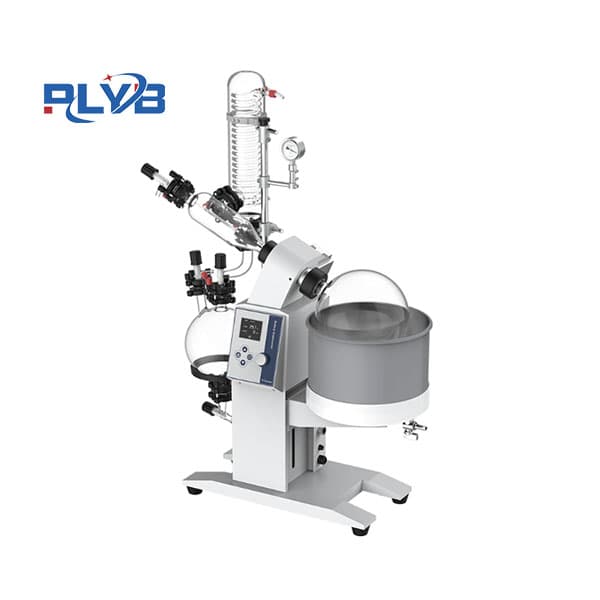
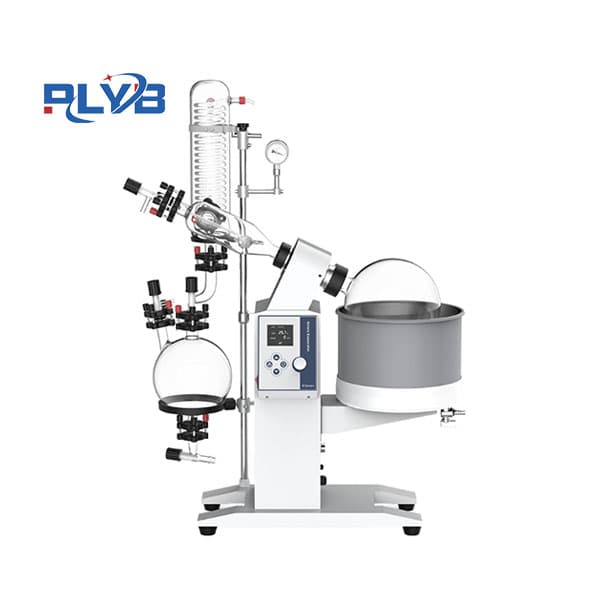
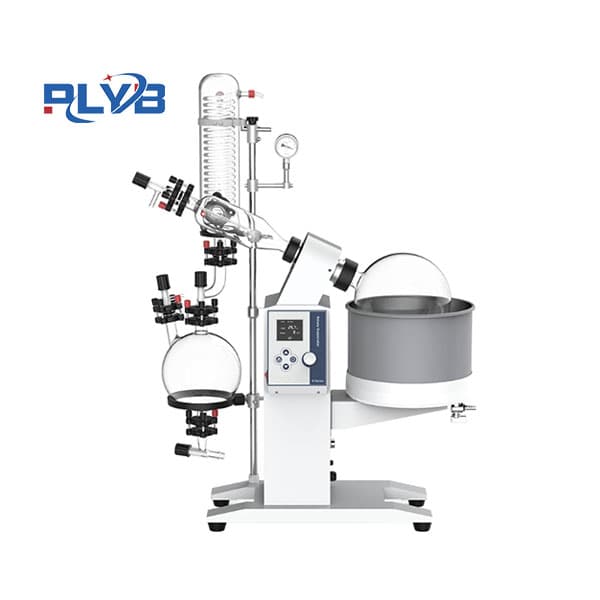
PLRE-50L Explosion-proof Rotary Evaporator
- Product Description
-
Introduction to the PLRE-50 Explosion-Proof Rotary Evaporator
The rotary evaporator is mainly employed in the pharmaceutical, chemical, and biopharmaceutical sectors for concentration, crystallization, drying, separation, and solvent recovery. Its working principle is: under vacuum, with temperature control, the rotating flask spins at a constant speed, allowing the material to spread into a wide‑area thin film on the flask’s inner wall, thus achieving highly efficient evaporation. The solvent vapor is condensed by a high‑efficiency glass condenser and collected in a receiving flask, significantly enhancing evaporation efficiency—making it particularly suitable for concentrating and purifying biological products that are prone to thermal decomposition or denaturation at elevated temperatures.
Our company's rotary evaporators incorporate the best features of similar products from both domestic and international markets, drawing on our own successful practical experience. We have developed a series spanning 2L, 5L, 10L, 20L, and 50L capacities. Our product designs adhere to the principles of high efficiency, practicality, and cost-effectiveness, always putting the user first.
The core advantages are:
The 50L rotary evaporator is primarily suited for pilot-scale workshops and small-batch production scenarios.
Large-capacity processing: It can handle 20–40L of material per batch, significantly enhancing solvent evaporation and concentration efficiency.
High recovery rate: Equipped with a high-efficiency vertical or serpentine condenser and a dual-condensation recovery system, the solvent recovery rate can reach over 95%, effectively reducing production costs.
Continuous feeding capability: Most 50L models support continuous feeding under vacuum conditions without the need to stop the machine and relieve pressure, meeting the demands of industrial-scale continuous production.
Performance and applicability of the 50L rotary evaporator:
1. Rotary Flask Volume and Material
50L models typically come standard with a 50L rotary flask (with ground glass or flanged connection), made of G3.3 high-borosilicate glass, which offers excellent resistance to high temperatures and corrosion. Some custom models may use titanium alloy or stainless steel to meet the requirements of special materials.
2. Heating Power and Temperature Control Range
The heating bath’s power typically ranges from 8 kW to 12 kW, with temperature control options spanning from ambient to 99°C (for water baths) and from ambient to 300°C (for oil baths). For high-boiling-point materials such as DMF or DMSO, it is recommended to choose an oil-bath model and pay close attention to temperature control accuracy (±1°C).
3. Motor and Rotational Speed
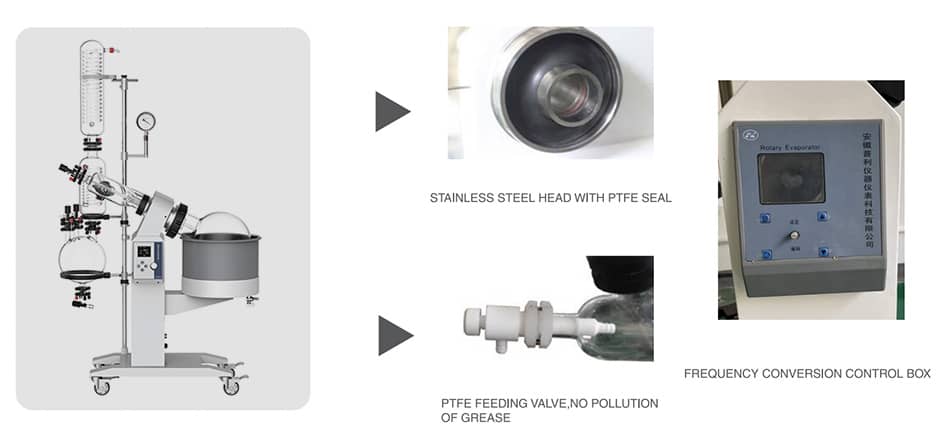
Motors typically use variable-frequency drives for speed control, with a typical speed range of 10–130 rpm. For flammable and explosive chemical solvents (such as ethanol, acetone, and ethyl acetate), it is essential to equip the system with explosion-proof motors and an explosion-proof control cabinet to ensure production safety.
4. Vacuum Level and Sealing Performance
The system’s ultimate vacuum level must reach at least 0.098 MPa. The key lies in the sealing components: PTFE composite seals or mechanical seals are standard on the 50 L model, effectively maintaining a high-vacuum environment and preventing material leakage.
5. Condensation System
For the 50 L rotary evaporator, it is recommended to use a vertical double‑stage high‑efficiency condenser, which increases the cooling surface area (typically ≥ 1.5 m²). Paired with circulating water cooling or a low‑temperature coolant circulation pump, this significantly enhances the recovery efficiency of low‑boiling-point solvents.
Technical Specifications of the Rotary Evaporator
Product Model
Product Model
PLRE-5 PLRE-10 PLRE-20 PLRE-50 Evaporation Flask (L)
Evaporation Flask (L)
5L/50# 10L/95# 20L/95# 50L/125# Collection Bottle (L)
Receiving Flask
2L/3L 5L 10L+5L 10L+10L Motor Power (W)
Motor Power
90 120 120 180 Bath Power (KW)
Bath Power
2 3 5 5 Vacuum Degree (Mpa)
Vacuum Degree
0.096 0.096 0.096 0.096 Rotation Speed (rpm)
Rotation Speed
10-90
5-110
5-110
8505-110
Evaporation Rate
H₂O (L/h)
Evaporation Speed
2 3.5 5 8 Power Supply
Power (V)
220 220 220 220 External Dimensions (cm)
Dimension
55*35*110 100*50*180 110*70*200 120*80*220 Explosion-proof configuration for a 50L rotary evaporator
For the application of a 50L rotary evaporator, explosion-proofing is a critical factor that must be carefully considered. If your production environment involves flammable and explosive organic solvents, be sure to confirm that the equipment is equipped with the following features:
Explosion-proof motor: Complies with Ex d II BT4 or higher explosion-proof rating.
Explosion-proof control cabinet: The PLC control panel must have explosion-proof functionality to enable remote operation and parameter setting.
Anti-static design: The entire equipment must be equipped with a grounding system to prevent static electricity buildup and potential safety hazards.
Safety Tip: When making your purchase, require the supplier to provide an explosion-proof certificate and relevant qualification documents. Never overlook safety risks in pursuit of cost reduction.
Typical Application Scenarios
Pharmaceutical Industry
Used for concentrating traditional Chinese medicine extracts and recovering solvents after the synthesis of chemical APIs. A batch processing capacity of 50L perfectly meets the transitional needs when scaling up from pilot-scale production to small-scale manufacturing, complying with GMP requirements for equipment materials and cleanliness.
Chemical Synthesis
In the production of pesticides, dyes, and fine chemicals, a 50L rotary evaporator is commonly employed for vacuum distillation of high-boiling-point materials, removing solvents from reaction systems and purifying the target product.
Food and Fragrances & Flavors
Used for low-temperature concentration of natural product extracts, maximizing the preservation of the activity and flavor of heat-sensitive components.
Environmental Protection and Wastewater Treatment
As a solvent recovery unit, it fractionates and recovers mixed waste liquids generated during production, enabling resource reuse and reducing hazardous waste disposal costs.
Related Products
Product Inquiry
Please leave your information, and we will contact you as soon as possible after receiving it. Thank you for your support!