简体中文
简体中文 English

Products
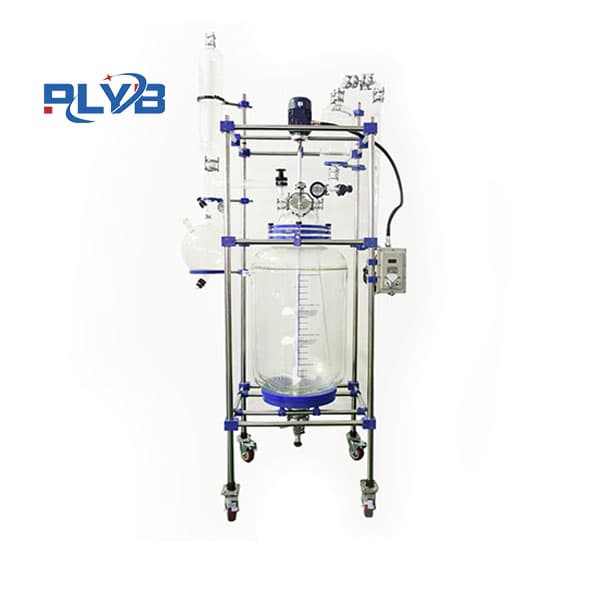
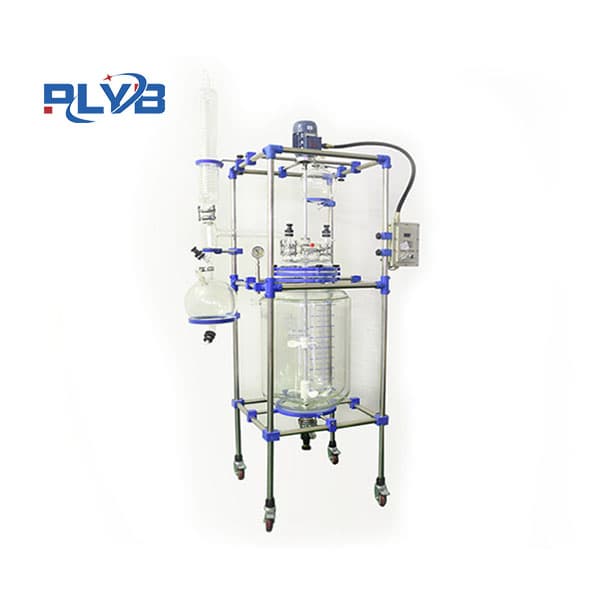
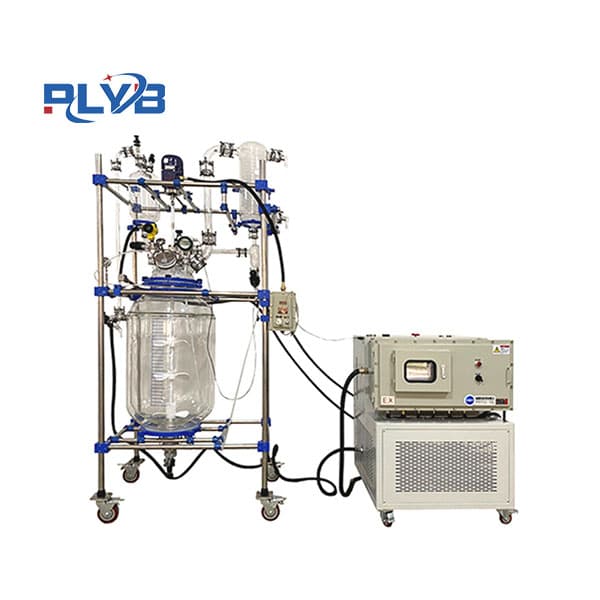
200L Double-Jacketed Glass Reactor
- Product Description
-
200L Double-Jacketed Glass Reactor with Integrated High- and Low-Temperature Unit:
I. Product Overview
The 200L double‑walled glass reactor paired with a high‑low temperature integrated unit is a complete temperature‑control system designed for scaled‑up pilot production and small‑batch manufacturing. This combination is widely used in the pharmaceutical, fine chemical, new materials synthesis, and biopharmaceutical industries, meeting precise temperature‑control requirements across a broad range from –80°C to +250°C, and serving as a critical piece of equipment that bridges pilot‑scale scale‑up and industrial production.
The 200L model, as a flagship for large-scale double-jacketed glass reactors, offers a moderate volume and well-established ancillary equipment, meeting the demands of batch production while retaining the unique advantages of glass reactors—transparency and ease of observation. The integrated high‑low temperature unit serves as the core temperature‑control system, combining heating and cooling in a single device; using the same heat-transfer fluid, it can maintain precise temperature control across the full range from low to high temperatures without the need to change the medium, ensuring convenient operation.
II. 200L Double-Jacketed Glass Reactor: The Core Equipment for Scale-Up and Pilot-Scale Testing
1. Reactor Vessel System
The 200L double‑jacketed glass reactor is manufactured from high‑borosilicate glass (GG17 material, with a thermal expansion coefficient of 3.3), offering excellent resistance to thermal shock and outstanding chemical stability. The effective reactor volume is 200L, with an interlayer capacity of approximately 40–60L, providing ample heat‑exchange space for temperature control.
The reactor vessel can withstand temperatures ranging from -80°C to +250°C, meeting the temperature requirements of most reaction processes. Its transparent design allows operators to visually monitor the reaction status, color changes, crystallization process, and layering—unique advantages that stainless steel reactors cannot match.
2. Stirring System
The stirring system is a critical component that ensures uniformity of the reaction. The 200L reactor is equipped with a high-torque variable-frequency motor, typically rated at 750W, with an adjustable speed range of 0–680 rpm or 0–780 rpm. It employs variable-frequency drive control for smooth and reliable operation.
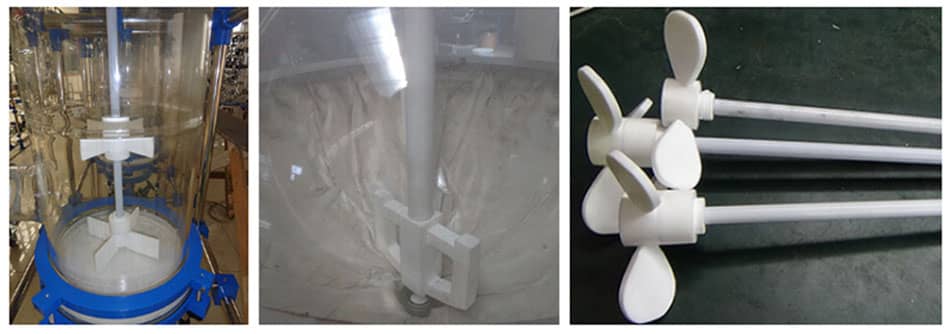
The agitator impeller features a 304 stainless steel core coated with polytetrafluoroethylene (PTFE), offering both high strength and excellent corrosion resistance. Agitation types include anchor, paddle, or propeller designs, allowing flexible selection based on the material’s viscosity characteristics. The agitator connection utilizes a universal joint to ensure smooth power transmission.
The sealing system employs ceramic bearings combined with a mechanical PTFE‑based seal, offering excellent gas tightness and achieving a vacuum level of up to 0.098 MPa, thereby meeting the requirements of most negative‑pressure reaction processes.
3. Reactor Head Interface Configuration
The 200L reactor head adopts a six-port flange structure, with a complete set of interfaces to meet multi-functional reaction requirements:
Stirring port: φ60mm flange, for mounting a stirrer
Solid feed port: φ80mm or 95mm flange, for convenient direct addition of solid materials
Constant-pressure funnel port: 40# or 50# ground joint, for dropwise addition of liquid materials
Condenser interface: 50# ground glass joint, for connecting a condensation apparatus
Temperature measurement port: φ45mm flange or 29# ground joint, for installing a PT100 temperature sensor
Vacuum/venting port: 34# standard joint, used for vacuuming or venting operations
4. Frame and Discharge System
The entire machine features a stainless steel frame (SU304 material), offering a compact and robust design. Equipped with casters fitted with brakes at the base, the unit can be moved as a whole, ensuring convenient operation.
The discharge valve adopts a side-discharge design that prevents liquid accumulation, constructed from glass and PTFE to avoid material residue and contamination. The discharge port is approximately 450 mm above the floor, facilitating easy placement of containers.
5. Condensation and Collection System
Standard configuration includes a high-efficiency vertical condenser with a condensing area of approximately 0.95–1.0 m², ensuring excellent condensation and recovery efficiency. It is equipped with a 10 L collection flask and a 5 L drop‑addition flask, meeting the material processing requirements of pilot‑scale operations.
III. 200L High-Low Temperature Integrated Unit: The Powerhouse of Precise Temperature Control
1. Temperature Control Range and Accuracy
The 200L integrated high-low temperature unit is a temperature-control device specially designed to match a 200L reactor. Its temperature control range can be customized according to process requirements, offering options such as -20℃ to +200℃, -30℃ to +200℃, or -80℃ to +200℃. Temperature control accuracy reaches ±0.5℃ to ±1℃, meeting the stringent limits on temperature fluctuations required for sensitive reactions.
2. Heating and Cooling Systems
The heating system uses electric heating tubes, with the total power of the unit typically ranging from 15 kW to 30 kW depending on the temperature control range. The cooling system employs imported hermetic compressors (such as Emerson Copeland), providing ample cooling capacity and enabling rapid temperature reduction.
It is particularly important to note that the actual cooling performance of a combined high‑low temperature unit is affected by the heat released during the reaction. Some users have reported that although the equipment is rated to reach -80°C, it can only achieve -40°C; upon investigation, this was found to be due to neglecting the heat generated by the reaction process. When selecting equipment, the reaction’s thermal load should be fully considered to ensure that the unit’s capacity matches the actual process requirements.
3. Closed‑Loop System
The integrated high‑and‑low temperature unit employs a fully sealed circulation system, equipped with an expansion vessel that is thermally insulated from the liquid circulation system and does not participate in the liquid loop. The advantages of this design are:
At low temperatures: no water vapor absorption, preventing condensate from contaminating the heat transfer fluid.
At high temperatures: no oil mist evaporation, and the heat transfer oil remains unoxidized and free from browning.
Extended service life: significantly prolongs the lifespan of the heat transfer medium.
4. Safety Protection Features
The equipment is fitted with multiple safety protection features, including delayed‑start protection, overcurrent protection, overheating protection, overtemperature protection, phase‑sequence protection, phase‑loss protection, and a high‑pressure switch, ensuring reliable long‑term operation.
IV. Operating Principles and Connection Specifications of the Complete System
1. Working Principle
The 200L double-layer glass reactor is connected to the high-low temperature integrated unit via piping, forming a closed-loop temperature control system:
1. The high-low temperature integrated unit heats or cools the heat transfer medium to the set temperature
2. A circulation pump delivers the medium through the outlet to the inlet at the bottom of the reactor
3. The heat transfer medium flows through the jacket, exchanging heat with the material inside the reactor
4. The heat transfer medium exits from the top outlet of the reactor and returns to the integrated unit for temperature regulation
5. The cycle repeats continuously, maintaining a constant reaction temperature
2. Piping Connection Standards
Piping connections must follow the “bottom-in, top-out” principle:
Dispensing port of the integrated unit → Liquid inlet at the bottom of the reactor
Liquid outlet at the top of the reactor → Return port of the integrated unit
This connection method ensures that the interlayer is completely filled with the heat-transfer fluid, preventing air pockets and achieving maximum heat-transfer efficiency. It is recommended to use stainless-steel corrugated tubing or temperature-resistant silicone tubing for the connecting lines, and to add an external insulation layer to minimize heat loss.
3. Media filling and draining
It is mandatory to use dedicated high- and low-temperature heat-transfer oils or synthetic silicone oils; water or ethylene glycol solutions are strictly prohibited, as they can generate vapor pressure at elevated temperatures, posing safety risks. When filling the heat-transfer oil, monitor the liquid-level gauge carefully—after activating the external circulation, the oil level will drop, so replenish the oil promptly to the proper level. Following filling, perform a venting procedure: activate the circulation system, slightly loosen the outlet fitting at the top of the reactor until you observe a continuous oil flow free of air bubbles, then tighten the fitting to expel any trapped air from the piping.
V. Parameter Table for the 200L Double-Jacketed Glass Reactor
Product Model
ProductModelPL-50L
PL-100L
PL-150L
PL-200L
Pot Capacity (L)
Volume (L)50
100
150
200
Number of pot openings
NeckNo.onCover6
6
6
6
InnerCylinderOuterDiameter
ExternalDiameterofInnerVessel(mm)365
460
550
600
OuterCylinderOuterDiameter
ExternalDiameterofOuterVessel(mm)410
500
600
650
Pot lid diameter
CoverDiameter(mm)265
340
340
340
Boiler Body Length
VesselHeight(mm)850
950
980
1200
Motor Power
MotorPower(W)180
370
750
750
Vacuum Degree
VacuumDegree(Mpa)0.098
0.098
0.098
0.098
Rotational Speed
RotationSpeed(rpm)50-600
50-600
50-600
50-600
Torque
Torque(Nm)2.86
5.89
11.90
11.90
Power Supply
Power (V)220
220
220
220
Overall Dimensions
Dimension (mm)700*500*2300
1000*700*2700
1200*900*3000
1200*900*3200
VI.Integrated High-Low Temperature Unit -40~200℃ Parameter Configuration Table
Model
PLYY-40-200
Cooling Capacity
15KW
Temperature Range
-40℃~200℃
Circulating Pump
Flow Rate & Pressure Max110L/min
2.5 barControl System
Fuzzy PID adaptive controller, PLC programmable controller
Compressor
Compressors from brands such as Emerson Copeland, Tecumseh, Duling, etc.
Temperature Control Mode
Material temperature control and equipment outlet temperature control modes are freely selectable
Expansion Valve
Danfoss/Emerson Thermal Expansion Valve
Program editing
PLC control allows programming of up to 5 programs, with each program capable of containing 40 steps.
Evaporator
Plate heat exchanger
Communication protocol
MODBUS RTU protocol, RS485 interface
Control Panel
PLC-controlled 7-inch color touchscreen, with temperature curve display and recording
External temperature feedback
PT100, 4–20 mA, or communication-based setpoint (default: PT100)
Safety Protection
Features self-diagnosis; compressor overload protection; high-pressure switch, overload relay, thermal protection device, and multiple other safety features.
Temperature Feedback
Equipment heat-transfer medium: three-point temperatures—inlet, outlet, and reactor material (with external temperature sensors)
Sealed System
The entire system is fully sealed—no oil mist at high temperatures, no absorption of atmospheric moisture at low temperatures, and no pressure rise due to heat during operation; the system automatically replenishes the heat-transfer fluid at low temperatures.
Thermal Fluid Temperature Control Accuracy
±0.5℃
Refrigerant
R-404A
Material Temperature Control Accuracy
±1℃
Power Supply
380V 50HZ
Heating Power
15KW
Housing Material
Plastic-coated Cold Plate or SUS304 Housing
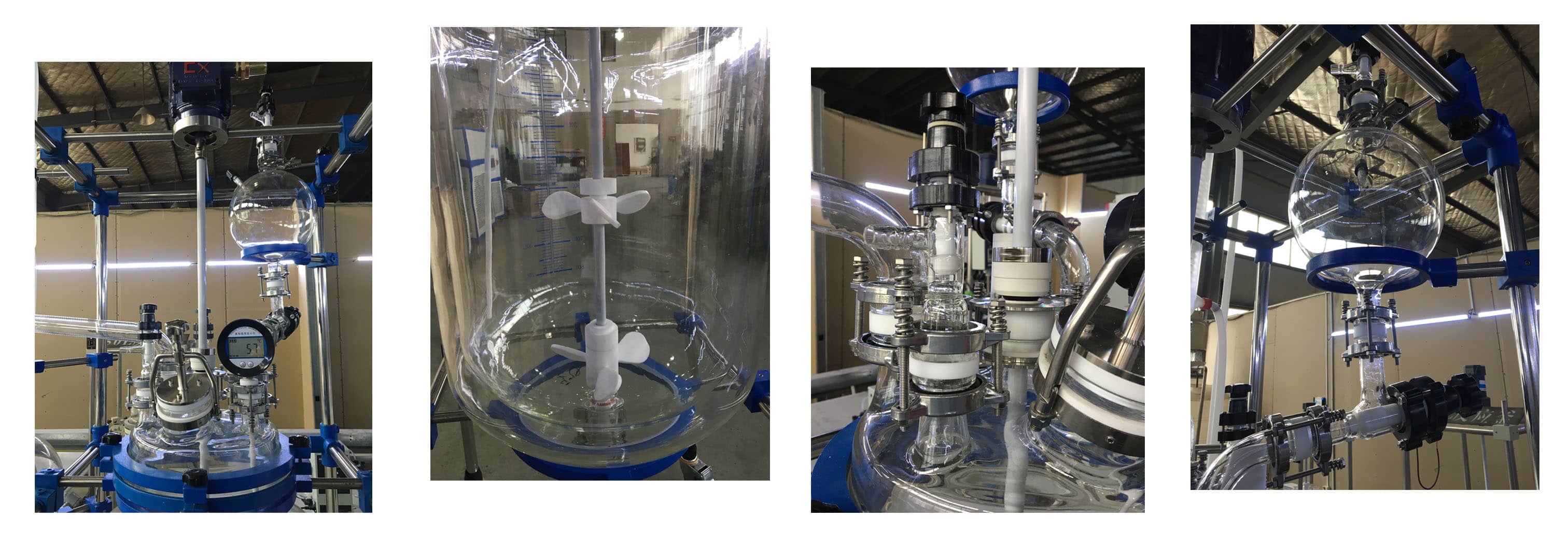
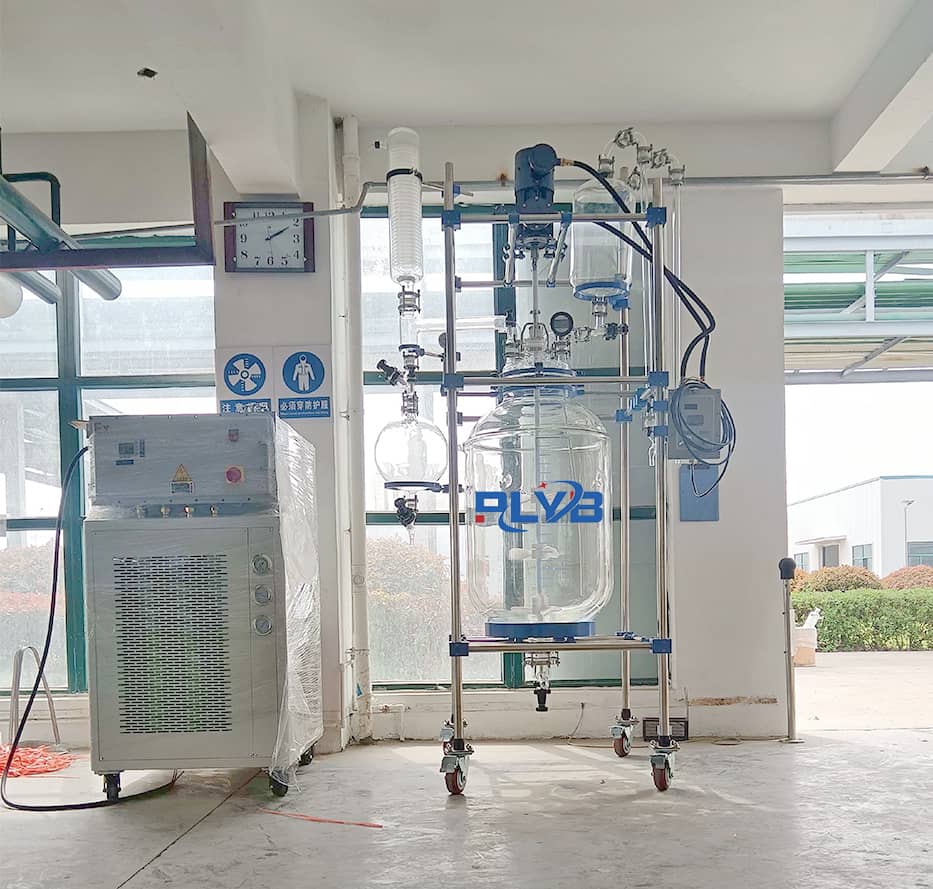
VII. Physical Images of the 200L Double-Jacketed Glass Reactor and the Explosion-Proof High/Low Temperature Integrated Unit
8. Core Application Areas
1. API Synthesis and Crystallization in the Pharmaceutical Industry
In the pilot-scale up‑scaling of active pharmaceutical ingredients, reaction temperature directly determines product purity and yield. The 200 L system enables precise control of temperature conditions during critical reaction stages, such as low‑temperature chiral synthesis (−40°C to −80°C), high‑temperature cyclization reactions (150–250°C), and programmed cooling crystallization, thereby ensuring process reproducibility and product quality.
2. Fine Chemical Product Development
Fine chemical reactions often involve significant exothermic effects, requiring rapid heat removal to control the reaction rate. The quick response of a combined high‑and‑low temperature unit allows timely switching to cooling mode during peak exothermic phases, ensuring safe and controlled reaction conditions. A 200L capacity is suitable for small‑batch production and process optimization of fine chemical products.
3. New Material Synthesis and Modification
Processes such as polymerization, nanomaterial synthesis, and lithium‑ion battery electrolyte development have stringent requirements for temperature uniformity. This 200L reactor is equipped with a high‑efficiency impeller that works in tandem with jacketed circulating temperature control, ensuring an even temperature distribution throughout the reaction system and excellent batch-to-batch consistency.
4. Extraction and Concentration of Natural Products
Extraction of active plant ingredients typically involves two stages: high-temperature extraction and low-temperature concentration. A 200L system can seamlessly complete both processes in a single unit, thereby minimizing losses and reducing the risk of contamination associated with material transfer, making it well-suited for applications such as traditional Chinese medicine extraction and the production of health supplement raw materials.
IX. Explosion-proof Selection and Safety Features
For processes involving flammable and explosive solvents, it is recommended to select explosion-proof equipment:
Explosion-proof motor: suitable for locations where explosive gas mixtures are present
Explosion-proof variable frequency drive: with an explosion-proof rating of ExdIIBT4
Explosion-proof controller: dual-display explosion-proof enclosure with digital display of speed and temperature
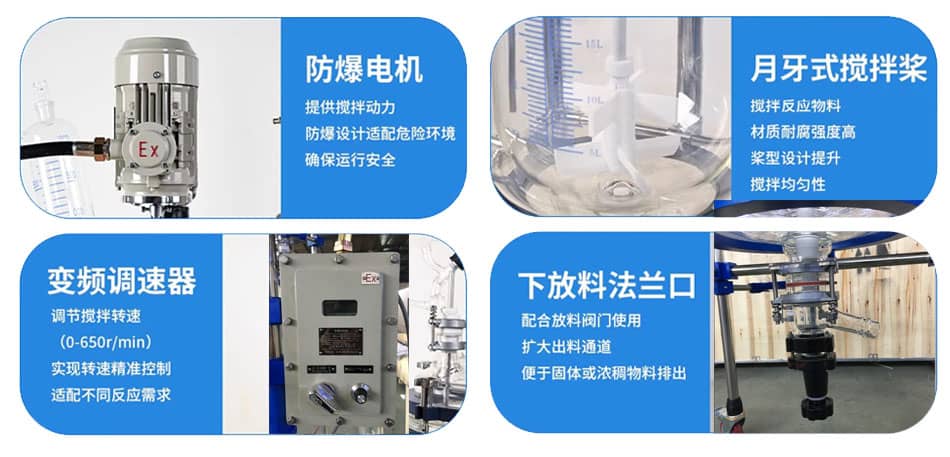
The explosion-proof high-low temperature integrated unit adds an explosion-proof function on the basis of the standard model; during installation, ensure electrical connections and environmental control comply with explosion-proof requirements.
X. Key Points for Use and Maintenance
1. Operating Precautions
Stepwise heating: For a 200L reactor with large material volume and significant thermal inertia, stepwise heating is recommended—raise the temperature by 30–50°C each time and hold it for a period to prevent excessive temperature differentials between the jacket and the reactor contents, which could cause the glass vessel to crack due to thermal stress.
Pressure Monitoring: The jacket pressure must not exceed 0.03–0.05 MPa; overpressure operation is strictly prohibited.
Vacuum Operation: First confirm that the jacket is at atmospheric pressure, then evacuate the reactor interior.
2. Media Maintenance
Heat transfer oil can be used continuously for 1–2 months without replacement, but regular inspections are required.
When the system is out of service for an extended period, drain the heat transfer oil and store it under sealed conditions.
Regularly test the oil quality and promptly replace any degraded medium.
3. Sealing System Maintenance
Regularly inspect the sealing ring, clean it, and apply vacuum grease. Method: Remove the sealing ring, check whether any dirt has accumulated on the shaft, wipe it clean with a soft cloth, then apply a small amount of vacuum grease before reinstalling.
4. Special Precautions During Winter
In winter, especially in northern regions, after use, drain the heat-transfer medium from the jacket to prevent freezing and cracking of the glass reactor vessel. When conducting experiments at low temperatures, the bottom discharge valve may frost over; thaw it locally before opening the valve to avoid shattering the glass.
Summary
The combination of a 200L double-jacketed glass reactor and a high-low temperature integrated unit represents the mainstream configuration for temperature control systems in scaled-up pilot production. This complete set of equipment features a wide temperature range (-80℃ to +250℃), high precision (±0.5℃), ease of operation, and reliable safety, meeting the process requirements for pilot-scale scale-up and small-batch production in fields such as pharmaceuticals, chemicals, and new materials.
As a flagship model in the realm of large-scale glass reactors, the 200L version combines the advantage of transparent, visual process monitoring with batch‑production capabilities, serving as a crucial bridge between laboratory R&D and industrial-scale manufacturing. Choosing this system will provide reliable technical support for your research and production efforts.
For more product information or to request a customized solution, please contact us. We will provide professional technical advice tailored to your specific process requirements.
Related Products
Product Inquiry
Please leave your information, and we will contact you as soon as possible after receiving it. Thank you for your support!