简体中文
简体中文 English

Products
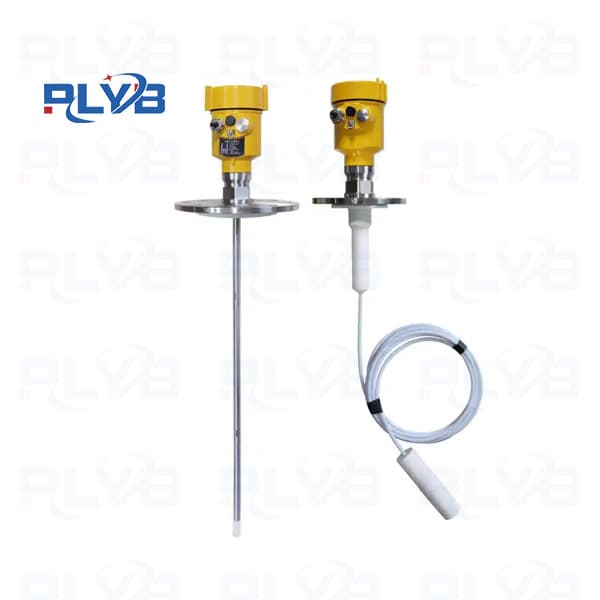
Rod guided wave radar level meter
- Product Description
-
The rod-type guided wave radar level meter is an instrument that uses a rigid metal probe to guide high-frequency microwave pulses for contact measurement. It is especially suitable for medium and small ranges, complex working conditions, or situations with poor medium characteristics.
It is essentially a time-domain reflectometer (TDR), but unlike conventional non-contact radar level meters. Its core advantage lies in energy concentration and minimal interference, especially excelling at stable operation in harsh environments such as steam, foam, and dust.
How it works: How is it measured?
Its principle can be summarized as: emission → conduction → reflection → calculation.
Emission pulse: The instrument's electronic unit emits an extremely short (nanosecond-level) low-energy microwave pulse.
Rod-Propagation: The pulse travels downward at the speed of light along the metal waveguide rod inserted into the medium.
Surface reflection: When the pulse reaches the surface of the measured medium, a sudden change in the dielectric constant (ε) produces strong reflection.
Reception and Calculation: The reflected pulse returns along the original path and is received by the instrument. By measuring the time difference (T) from transmit to receiver, the level (L) can be calculated.
Core calculation formula: D = C × t / 2; Material level L = total tank height E - distance D
Core components and types: Types of rod-type probes
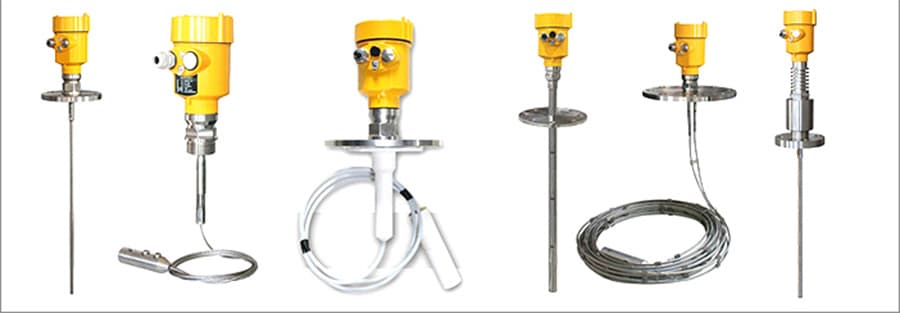
The core component of rod-type guided wave radar is its metal guided wave probe, which mainly comes in several forms:
Single-rod type: Simple and stable structure, composed of a single metal rod, not prone to material attachment, suitable for measuring viscous liquids or solid particles.
Dual-rod type: Composed of two parallel metal rods, enhancing the focusing capability of the microwave field and significantly improving echo signal strength from the surface of low dielectric constants to ensure stable measurement.
Coaxial type: A metal sleeve is added outside the metal rod to form a coaxial structure. It can completely block external interference, providing the most stable and reliable measurement signals, especially suitable for liquids with extremely low dielectric constants or extremely harsh environments.
Main features: Overview of core advantages
High precision and strong anti-interference capability: Electromagnetic pulses propagate along the probe, concentrating energy and unaffected by obstacles, steam, foam, or dust inside the tank, ensuring stable and reliable measurement.
Easy installation: Instruments are usually installed directly on the tank top via standard flanges or threads, requiring no complicated adjustments.
Wide range of applications: Can be used to measure liquids, slurries, granules, and even powders, with applications covering many industries including petroleum, chemical, power, food, and water treatment.
Good process adaptability: The medium temperature range is wide (-200°C to +400°C), with process pressures up to 40MPa.
Key Points for Selection: How to Choose Correctly?
When choosing the right model, pay special attention to the following parameters and operating conditions:
Key parameters Typical values/range Measurement range 0.5m ~ 6m Process temperature -50℃ ~ 520℃ Process pressure -0.1MPa ~ 42MPa Accuracy ±10mm Signal output 4-20mA HART、RS485 Modbus Explosion-proof rating Ex db IIC T6 Here are some selection recommendations for common working conditions to help you make decisions based on your actual needs:
Operating scenarios Recommended probe type Reasons for selection and considerations Viscous liquid, not easy to stick to material Single-rod style The structure is simple and stable, not easy to catch material, and highly adaptable. Low dielectric constant
media (such as liquefied gas, light oil)Double-rod type First choice. It can enhance signal reflection and ensure measurement stability in low dielectric constants. Harsh operating conditions
(strong interference, extremely low dielectric constant)Coaxial type Measurement is the most stable and reliable, fully shielding against external interference. Corrosive media
(strong acids, strong bases)Full PTFE sealed type The probe is fully encased in PTFE material, providing excellent corrosion resistance. There is vigorous stirring Use with caution The stirring paddle may generate lateral forces that cause probe rods to bend or break, so mechanical strength assessment and optimal installation position are required. High-viscosity, easily crystallizing medium Single-rod style Tracing or purge functions may be necessary to prevent material slag from affecting measurements. Applications and limitations
Main applications
Chemicals and petrochemicals: Used for liquid level monitoring in reactors and storage tanks, such as various solvents, acids and bases, and oils.
Food and pharmaceuticals: suitable for tanks with certain hygiene requirements, such as measuring milk, syrup, and medicinal liquids.
Power and water treatment: Used for liquid level control in pools, tanks, acid-base storage tanks, lime slurry tanks, etc.
Boundary measurement: When two liquids are miscible and their dielectric constants differ, it can be used to measure their interface height.
Main limitations and precautions
Range Limitations: Due to transportation and installation constraints, the maximum measurement range of pole radar is usually limited to within 6 meters.
Mechanical strength issues: In tanks with strong stirring or fluid impact, the probe's resistance to bending and lateral forces must be considered.
Material hanging and crystallization: In high-viscosity, easily crystallized, or easily cagging media, deposits may affect measurement.
Installation requirements: During installation, ensure that the probe rod maintains a certain distance from the tank wall and internal obstacles to avoid signal interference.
Summary
The rod-type guided wave radar level meter is a robust choice designed for small to medium ranges, complex environments, or poor media characteristics. It excels in anti-interference, accuracy, and adaptability, making it a reliable solution to many industrial level measurement challenges.
Related Products
Product Inquiry
Please leave your information, and we will contact you as soon as possible after receiving it. Thank you for your support!